- 5 min read
- 16 Feb, 2026
- Shane Cooke
Ix Cacao in Mesoamerican Cosmology: Beyond Myth, Into Sacred Structure
When we speak of Ix Cacao, we are not entering a children’s story. We are stepping into the cosmological architecture of the ancient Maya, where agriculture, divinity, economy, and time were inseparable.
Ix Cacao refers to a female cacao deity identified in Classic and Postclassic Maya iconography and inscriptions. Her presence reflects a worldview in which cacao was not merely consumed, but understood as a sacred agricultural force embedded in cosmic order.
The Meaning of “Ix”
In several Mayan languages, Ix functions as a feminine prefix. It is associated with womanhood, the moon, fertility, weaving, earth, and generative power.
Within Maya cosmology, the feminine principle was not passive. It was creative, cyclical, and foundational. When cacao is linked with “Ix,” it situates the plant within this matrix of fertility and life-giving energy.
Cacao as a Cosmological Bridge
For the Maya, reality was structured into three interwoven realms:
- The Underworld (Xibalba) — the place of darkness, gestation, and ancestral presence
- The Middle World — the human realm of cultivation and social life
- The Celestial Realm — the domain of deities, celestial bodies, and sacred time
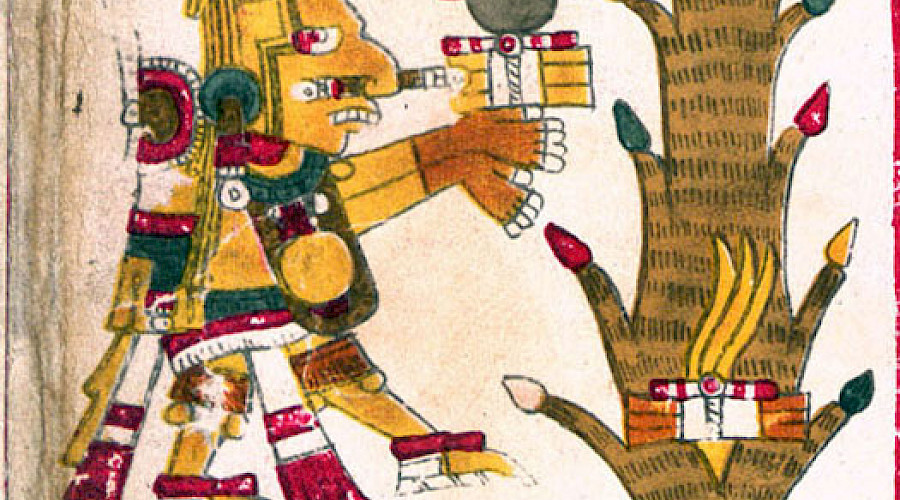
Cacao trees were sometimes depicted symbolically as world trees, linking these realms. Seeds germinate in darkness, rise into visible life, and produce fruit that nourishes community and ceremony. This cycle mirrored the broader cosmological understanding of death, rebirth, and continuity.
Cacao therefore functioned as a botanical expression of cosmic balance.
Archaeology and Iconography
Archaeological findings confirm cacao’s elevated status. Classic Maya pottery often bears glyphic inscriptions reading ka-ka-wa, identifying vessels used for cacao beverages. These vessels are frequently associated with elite burials and ceremonial contexts.
Codex-style imagery depicts deities interacting with cacao trees or emerging from cacao pods, reinforcing the plant’s connection to divine fertility. The pod itself, with seeds enclosed in protective flesh, carried symbolic resonance with themes of gestation and abundance.
This was not decorative symbolism. It reflected a worldview in which agricultural success was inseparable from divine harmony.
Ritual, Economy, and Social Order
- Cacao operated simultaneously in spiritual and material dimensions:
- Used in marriage negotiations and dowries
- Exchanged as currency and tribute
- Consumed in elite feasting rituals
- Offered to deities and ancestors
Its economic value strengthened political alliances, while its ritual use affirmed cosmic alignment. Drinking cacao in ceremony was not indulgence. It was participation in sacred reciprocity.
Fertility Beyond the Biological
Ix Cacao’s association with fertility extends beyond reproduction. In Maya cosmology, fertility encompassed:
- Crop abundance
- Lineage continuity
- Rainfall cycles
- Political stability
- Ecological balance
A thriving cacao harvest signaled harmony between humans, land, and the unseen forces governing time and weather.
Historical Context
It is important to differentiate between documented iconography and later folkloric elaborations. While references to cacao deities appear in codices and colonial-era accounts, much of the narrative detail shared today expands upon fragmentary sources.
What remains consistent, however, is the cosmological role of cacao. It was not peripheral. It was structurally embedded in Maya metaphysics.
Closing Reflection
Ix Cacao represents more than a goddess figure. She embodies a cosmological principle: that nourishment, fertility, and sacred order are interconnected.
To understand cacao in its original context is to see it not as a commodity, but as a plant positioned at the intersection of agriculture, ritual, economy, and cosmic design.
Within Maya thought, cacao was a living thread binding earth to sky, seed to lineage, and human life to divine rhythm.